Iodine Clock Reaction Experiment: A Comprehensive Guide
This guide details the iodine clock reaction, exploring its kinetics and procedures, offering a robust model for understanding reaction rates and data analysis, as found in a PDF.
The iodine clock reaction is a fascinating chemical demonstration exhibiting a distinct and visually striking change in color after a delayed period. This delay, the “clock” aspect, arises from the interplay of two reactions: one that slowly produces iodine, and another that rapidly consumes it. The reaction’s name stems from this timed color change, typically from colorless to a dark blue-black, signaling a specific endpoint.
Often studied in introductory chemistry labs, the iodine clock reaction provides an excellent platform for exploring chemical kinetics, reaction mechanisms, and the influence of various factors on reaction rates. A readily available iodine clock reaction experiment PDF will detail the procedure, safety precautions, and data analysis techniques. It’s a robust model for understanding how concentrations and temperature affect the speed at which chemical reactions occur, making it a valuable educational tool.
Historical Context and Discovery
The origins of the iodine clock reaction aren’t attributed to a single discoverer, but rather evolved through the work of several chemists in the late 19th and early 20th centuries. Early investigations into iodine kinetics laid the groundwork, with researchers observing the delayed color change as a consequence of competing reaction rates. The precise mechanisms were gradually elucidated as analytical techniques improved.
While pinpointing a definitive “discovery” is difficult, the reaction gained prominence as a pedagogical tool in the mid-20th century. Numerous iodine clock reaction experiment PDF resources emerged, standardizing procedures and facilitating its use in educational settings. These documents often detail the historical development alongside the experimental protocol. The reaction’s simplicity and dramatic visual effect ensured its continued popularity in chemistry education, demonstrating fundamental kinetic principles.
The Chemistry Behind the Clock Reaction
The iodine clock reaction is fundamentally a demonstration of chemical kinetics, showcasing how reaction rates influence observable changes. It involves two primary reactions: one generating iodine (I2), and another consuming it. The “clock” aspect arises because the initial iodine production is slow, but once a certain concentration is reached, it reacts rapidly with starch, creating a sudden blue-black color.
A typical iodine clock reaction experiment PDF will detail the reactants – often potassium iodide, sodium thiosulfate, potassium persulfate, and starch. The persulfate oxidizes iodide to iodine, while thiosulfate reduces the iodine back to iodide, effectively masking its presence until the thiosulfate is depleted. This interplay between oxidation and reduction drives the observable color change. Understanding these redox processes is crucial for interpreting the experimental results.
Reaction Mechanism: A Detailed Breakdown
The iodine clock reaction’s mechanism unfolds in several steps, typically outlined in an iodine clock reaction experiment PDF. Initially, persulfate (S2O82-) oxidizes iodide ions (I–) to form iodine (I2). Simultaneously, the generated iodine is immediately reduced back to iodide by thiosulfate ions (S2O32-), preventing any visible color change.
This continues until all the thiosulfate is consumed. At this point, any further iodine produced remains unreacted and complexes with starch, forming the characteristic deep blue-black color. The time it takes for this color change to occur is directly related to the reaction rates of both processes. Detailed PDFs often present these steps as individual equations, allowing for a quantitative analysis of the reaction kinetics and rate law determination.
Role of Iodate Ion (IO3-) in the Reaction
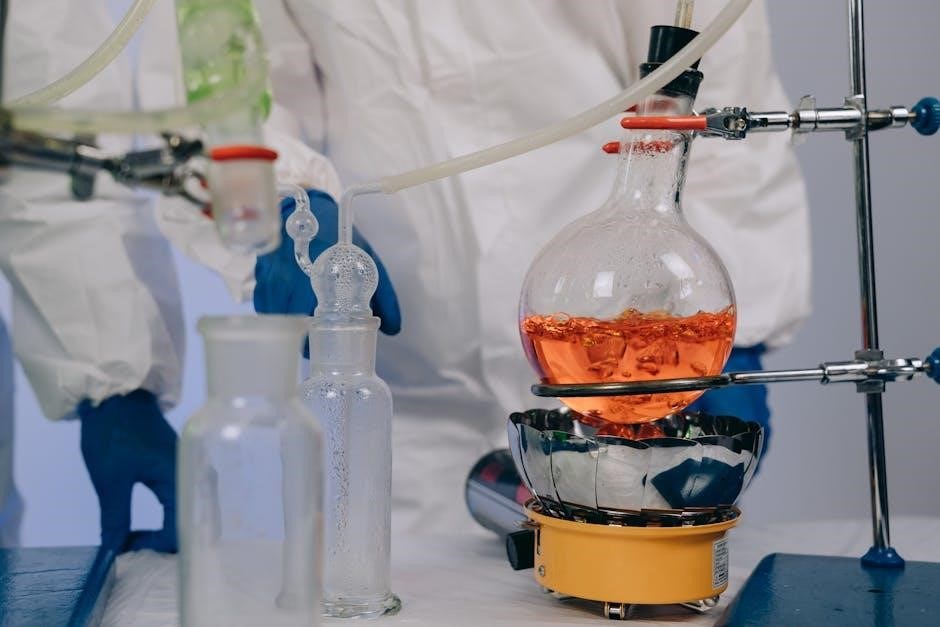
In iodate-based variations, detailed within an iodine clock reaction experiment PDF, the iodate ion (IO3–) serves as the primary oxidant. It reacts with iodide ions (I–) in an acidic environment, generating iodine (I2). This process is crucial as it provides a controlled and sustained release of iodine, unlike direct oxidation with persulfate.
The rate of iodine production from iodate is dependent on the concentration of both iodate and iodide, alongside the acidity of the solution. PDFs emphasize that this controlled release is key to the “clock” aspect, allowing for precise timing measurements. The subsequent reaction with thiosulfate, and the final starch indicator color change, remain consistent with other iodine clock reaction setups, making it a robust model for kinetic studies.

The Two Half-Reactions Involved
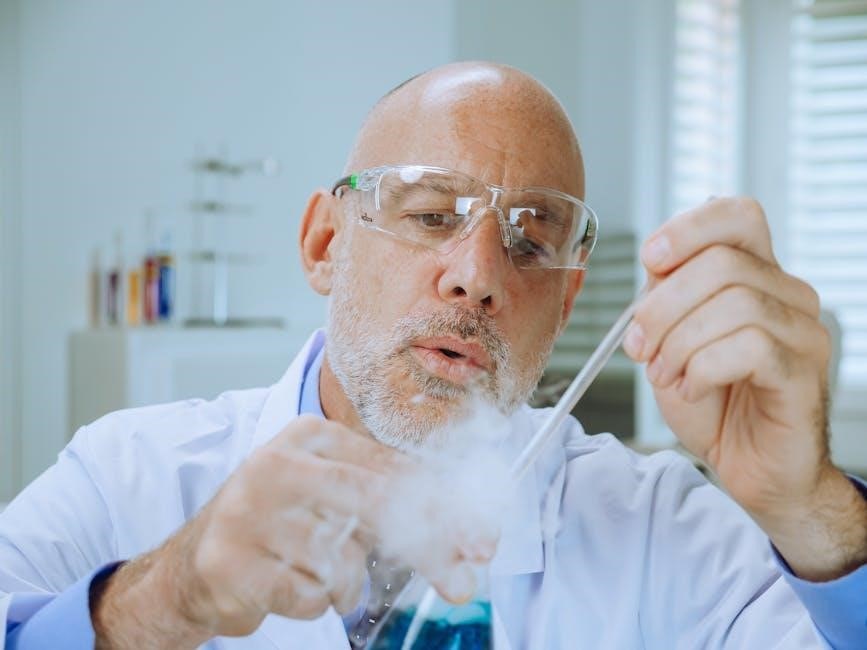
An iodine clock reaction experiment PDF details two crucial half-reactions driving the process. The first is the oxidation of iodide ions (I–) by iodate ions (IO3–) in an acidic solution, producing iodine (I2). This is represented as: IO3– + 5I– + 6H+ → 3I2 + 3H2O.
Simultaneously, the second half-reaction involves the rapid consumption of the generated iodine by thiosulfate ions (S2O32-), reforming iodide: I2 + 2S2O32- → 2I– + S4O62-. The PDF clarifies that as long as thiosulfate is present, the iodine is immediately reduced, preventing its detection. Once thiosulfate is depleted, free iodine accumulates, reacting with starch to form the characteristic blue complex, signaling the “clock” event.
Experimental Procedure: Step-by-Step Guide
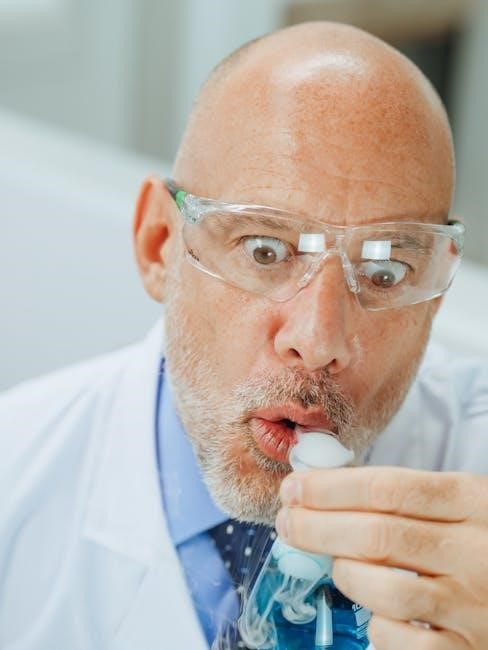
A typical iodine clock reaction experiment PDF outlines a precise procedure. First, prepare solutions of potassium iodide, sodium thiosulfate, starch, and potassium iodate, noting concentrations carefully. Combine solutions A (potassium iodide, thiosulfate, and starch) and B (potassium iodate) in a beaker.
The PDF emphasizes precise timing; start a timer immediately upon mixing. Observe the solution for a color change – the appearance of a dark blue color indicates the reaction’s endpoint. Record the time taken for this color change. Repeat the experiment multiple times, varying reactant concentrations as directed in the PDF, to gather data for kinetic analysis. Ensure thorough mixing and consistent temperature control throughout the experiment for accurate results.
Materials Required for the Experiment
An iodine clock reaction experiment PDF typically lists essential materials. These include potassium iodide (KI), potassium iodate (KIO3), sodium thiosulfate (Na2S2O3), and soluble starch. You’ll need distilled water for solution preparation, alongside beakers, graduated cylinders, and pipettes for accurate volume measurements.
A timer or stopwatch is crucial for recording reaction times. A thermometer ensures temperature control, vital for kinetic studies. The PDF may also suggest using a magnetic stirrer and stir plate for consistent mixing. Safety goggles are mandatory for eye protection, and gloves are recommended to prevent skin contact with chemicals. Finally, a clear background is helpful for observing the color change accurately.
Safety Precautions During the Experiment
A comprehensive iodine clock reaction experiment PDF will emphasize safety. Always wear approved safety goggles to protect your eyes from chemical splashes, as potassium iodate can cause irritation. Gloves are recommended to prevent skin contact with the solutions, minimizing potential allergic reactions or staining.
Work in a well-ventilated area to avoid inhaling any fumes, though these are generally minimal. Dispose of chemical waste properly, following your institution’s guidelines – do not pour solutions down the drain. Be cautious when handling glassware to avoid breakage. Familiarize yourself with the hazards of each chemical before starting, and have a spill cleanup plan readily available. Report any accidents or spills to your instructor immediately.
Factors Affecting Reaction Rate
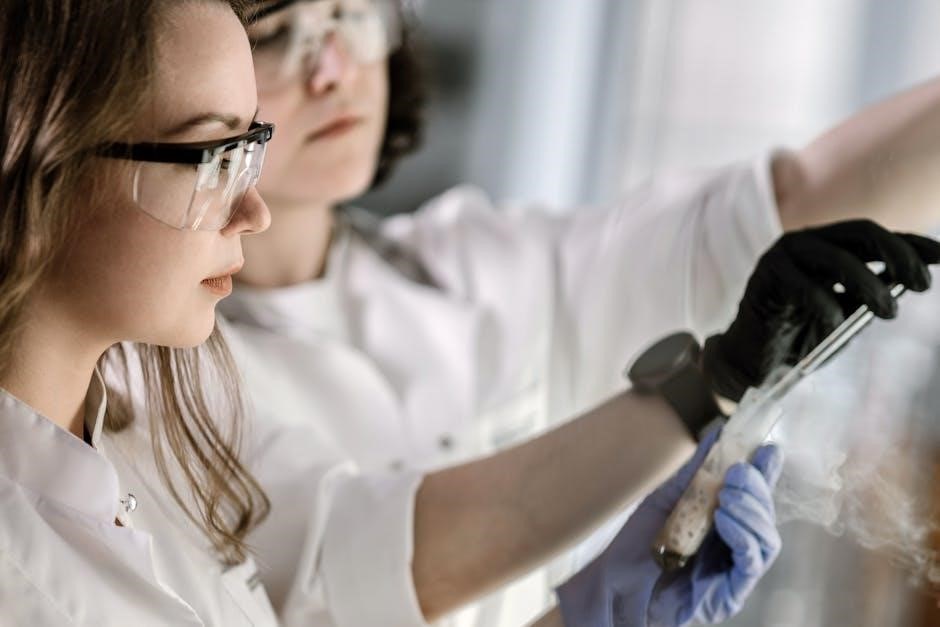
An iodine clock reaction experiment PDF will detail how several factors influence the reaction’s speed. Concentration of reactants is key; increasing concentrations generally lead to faster rates, as described by the rate law. Temperature significantly impacts the reaction – higher temperatures provide more kinetic energy, increasing collision frequency and, consequently, the reaction rate.
The presence of catalysts, though not typically used in the basic clock reaction, could also accelerate the process. Surface area, if solids are involved (which isn’t common in this specific experiment), plays a role. Understanding these factors allows for controlled manipulation and accurate kinetic data collection, crucial for determining the rate law and activation energy.
Concentration of Reactants and its Impact
An iodine clock reaction experiment PDF emphasizes the direct correlation between reactant concentrations and reaction rate. Increasing the concentration of reactants – persulfate, iodide, and iodate – generally accelerates the reaction, as more molecules are available to collide and react. This relationship is mathematically defined by the rate law, which expresses the rate as a function of reactant concentrations.
The rate law’s exponents reveal the order of the reaction with respect to each reactant. Determining these orders experimentally, using initial rates methods detailed in the PDF, is a core objective. Careful control and variation of initial concentrations are vital for accurate rate law determination and understanding the reaction’s kinetics.
Temperature Dependence and Activation Energy
An iodine clock reaction experiment PDF highlights the significant impact of temperature on reaction rate. As temperature increases, the reaction proceeds faster due to increased molecular kinetic energy, leading to more frequent and energetic collisions. This relationship is quantified by the Arrhenius equation, which links the rate constant to temperature and activation energy.
The activation energy (Ea) represents the minimum energy required for a reaction to occur. The PDF details methods for estimating Ea from temperature-dependent rate data, often by plotting ln(k) versus 1/T. A steeper slope indicates a higher activation energy, signifying a greater temperature sensitivity of the reaction rate. Understanding this dependence is crucial for optimizing reaction conditions.
Determining the Rate Law
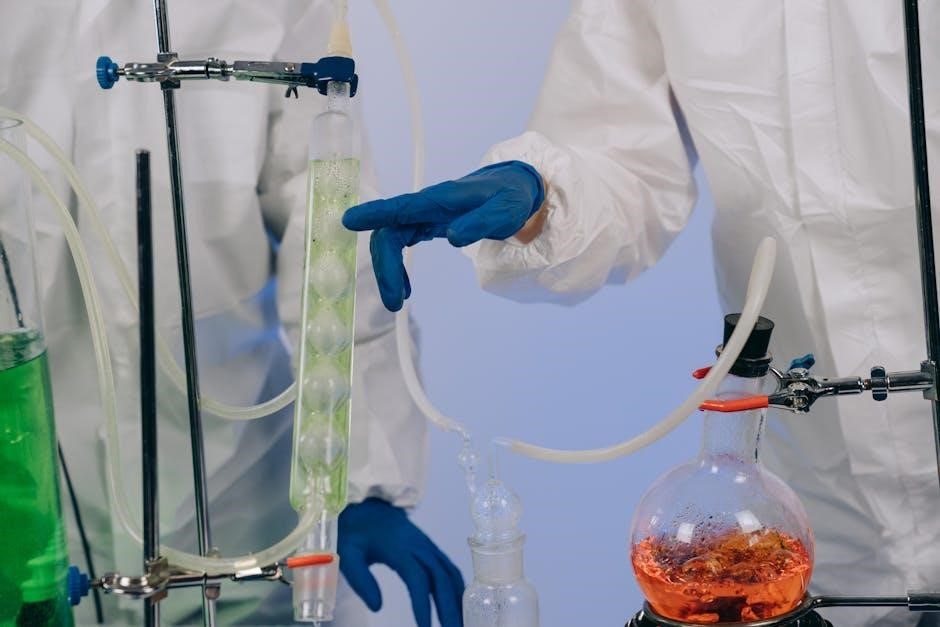
An iodine clock reaction experiment PDF emphasizes utilizing the method of initial rates to determine the rate law. This involves measuring the reaction rate at different initial concentrations of reactants while keeping others constant. By comparing how changes in concentration affect the initial rate, one can deduce the order of the reaction with respect to each reactant.
The rate law expresses the relationship between reaction rate and reactant concentrations, typically in the form: rate = k[A]m[B]n. The PDF guides you through analyzing kinetic data to find the exponents ‘m’ and ‘n’, representing the reaction orders. This process allows for a quantitative understanding of how reactant concentrations influence the reaction’s speed.
Method of Initial Rates Explained
The iodine clock reaction experiment PDF details the method of initial rates as a crucial technique for rate law determination. This method focuses on measuring the instantaneous rate of reaction at the very beginning – the initial rate – for several experimental runs. By varying the initial concentration of one reactant while holding others constant, the impact on the initial rate is observed.
This approach minimizes complications from reverse reactions and product accumulation, providing a more accurate representation of the forward reaction’s kinetics. The PDF explains how to calculate the initial rate from the time it takes for the solution to change color, signaling a specific amount of iodine production. Analyzing these rates allows for direct determination of reaction orders.
Calculating the Rate Constant (k)
The iodine clock reaction experiment PDF guides users through calculating the rate constant (k) once the rate law is determined. Knowing the rate law – expressing the relationship between rate and reactant concentrations – allows for isolating ‘k’. The PDF emphasizes substituting the experimentally determined initial rates and concentrations into the rate law equation.
Solving for ‘k’ yields a numerical value specific to the reaction at a given temperature. The units of ‘k’ depend on the overall reaction order; the PDF provides examples for different order reactions. Accurate calculation of ‘k’ is vital for quantitatively describing the reaction’s speed and predicting its behavior under varying conditions. This constant is fundamental to understanding chemical kinetics.
Data Analysis and Interpretation
The iodine clock reaction experiment PDF stresses meticulous data recording – specifically, the time taken for the solution to change color. This time directly correlates to the amount of iodine produced. The PDF details how to convert these time measurements into initial rates of reaction, crucial for determining the rate law.
Analyzing kinetic data involves plotting various combinations of reactant concentrations against the initial rates. The PDF guides users in identifying the reaction order with respect to each reactant based on these graphical relationships. Interpretation requires careful consideration of slopes and intercepts, linking them directly to the rate constant (k). Proper analysis unlocks insights into reaction mechanisms.
Analyzing Kinetic Data for Rate Law Determination
The iodine clock reaction experiment PDF emphasizes systematic analysis of collected data to deduce the rate law. This involves varying the initial concentrations of reactants while keeping others constant, then observing the corresponding changes in the initial reaction rate. The PDF instructs users to plot this data, typically using logarithmic scales, to visually determine the reaction order with respect to each reactant.
For instance, a linear plot on a log-log scale indicates a first-order reaction. The PDF provides detailed examples of how to interpret these plots and extract the rate constant (k). Careful attention to experimental precision and error analysis, as outlined in the PDF, is vital for accurate rate law determination.
Estimating Activation Energy from Temperature Data
The iodine clock reaction experiment PDF guides users through estimating activation energy (Ea) using the Arrhenius equation. This involves conducting the experiment at several different temperatures and determining the rate constant (k) at each temperature. The PDF details how to plot ln(k) versus 1/T (inverse temperature) – a linear relationship where the slope is -Ea/R (R being the ideal gas constant).
By calculating the slope from the graph, the activation energy can be determined. The PDF stresses the importance of accurate temperature control and measurement. It also highlights potential sources of error and how to minimize their impact on the Ea calculation, ensuring reliable results from the experiment.
Variations of the Iodine Clock Reaction
The iodine clock reaction experiment PDF explores variations beyond the standard persulfate-iodide system. While the iodate-based reaction is highlighted as a robust model for studying chemical kinetics, the PDF acknowledges other clock reaction systems exist. These alternatives often utilize different oxidizing agents or indicator systems to achieve a similar visually observable endpoint – the sudden appearance of a blue color due to iodine formation.
The document details how these variations can be used to investigate different reaction mechanisms and explore the impact of various factors on reaction rates. It emphasizes that understanding the core principles allows adaptation to diverse experimental setups, broadening the scope of kinetic studies.
Iodate-Based Reaction: A Robust Model
The iodine clock reaction experiment PDF emphasizes the iodate-based reaction as a particularly reliable and well-characterized system for demonstrating chemical kinetics. This variation offers several advantages, including a clear and easily observable endpoint – the abrupt color change signaling iodine accumulation. The PDF details how the iodate ion (IO3-) plays a crucial role in the reaction mechanism, acting as a controlled source of iodine.
Its robustness stems from the predictable reaction rates and relatively simple experimental setup, making it ideal for introductory kinetics labs. The document highlights its suitability for determining rate laws and calculating activation energies, providing a solid foundation for understanding more complex reaction systems.
Other Clock Reaction Systems
While the iodine clock reaction experiment PDF primarily focuses on the iodate-based model, it acknowledges the existence of alternative clock reaction systems. These variations utilize different chemical reactions to achieve the same characteristic delayed color change, offering opportunities for comparative studies. Examples include systems based on persulfate and arsenite, or hydrogen peroxide and iodide, each with unique kinetic profiles.
The PDF briefly touches upon these alternatives, noting their potential for exploring different reaction mechanisms and complexities. However, it reinforces the iodate system’s advantages in terms of simplicity, clarity, and ease of data analysis for introductory experiments. Exploring these alternatives can broaden understanding of chemical kinetics principles.
Applications and Further Research
The iodine clock reaction experiment PDF demonstrates fundamental principles of chemical kinetics applicable to diverse fields. Understanding reaction rates and mechanisms is crucial in areas like pharmaceutical development, environmental monitoring, and industrial process optimization. This experiment serves as a foundational model for investigating more complex reaction systems.
Further research could explore the impact of catalysts on reaction rate, investigate the reaction’s sensitivity to pH changes, or analyze the effects of different ionic strengths. The PDF suggests extending the study to examine the reaction under non-ideal conditions, potentially mirroring real-world scenarios. Investigating the reaction’s behavior with varying light exposure could also yield valuable insights.
Real-World Applications of Chemical Kinetics
The principles demonstrated in the iodine clock reaction experiment PDF extend far beyond the laboratory, underpinning numerous real-world applications of chemical kinetics. In the pharmaceutical industry, understanding reaction rates is vital for drug development and stability testing, ensuring medication efficacy and shelf life. Environmental science utilizes kinetics to model pollutant degradation and predict environmental impact.
Industrial chemistry relies heavily on optimizing reaction rates for efficient production processes. Food science employs kinetic studies to determine food spoilage rates and preservation methods. Even in human biology, enzymatic reactions – fundamental to life – are governed by kinetic principles. The experiment’s insights into factors affecting reaction rates, like concentration and temperature, are universally applicable.
Potential Areas for Further Investigation
Expanding upon the iodine clock reaction experiment PDF, several avenues invite further exploration. Investigating the impact of different catalysts on reaction rate, beyond those traditionally used, could reveal novel kinetic behaviors. A detailed study of the reaction’s sensitivity to pH variations would provide a more comprehensive understanding of its influencing factors.
Furthermore, exploring the reaction’s behavior in non-aqueous solvents could uncover unique solvent effects on the rate law. Utilizing more sophisticated analytical techniques, such as spectrophotometry with real-time data acquisition, could enhance the precision of kinetic measurements. Finally, computational modeling could be employed to simulate the reaction mechanism and validate experimental findings, deepening our understanding of this classic chemical demonstration.