Discover a comprehensive 5-day per week muscle building program in PDF format, designed to maximize gains and optimize your training experience.
This detailed guide, suitable for all levels, offers varied exercises, nutritional advice, and tips to achieve your fitness goals effectively.
What is a 5-Day Split?
A 5-day split is a workout routine where you dedicate each of five days to training specific muscle groups. This approach, often found within a programme musculation 5 jours par semaine PDF, allows for focused attention on each area, promoting optimal muscle recovery and growth.
Unlike full-body workouts performed multiple times a week, a 5-day split divides training volume, enabling higher intensity and more exercises per muscle group. Common splits include upper/lower body combinations, push/pull/legs, or targeting individual muscle groups like chest/triceps, back/biceps, and shoulders/legs. This structure, detailed in many PDF guides, is ideal for intermediate to advanced lifters seeking significant muscle development and strength gains.
Benefits of a 5-Day Workout Routine
A 5-day workout routine, often detailed in a programme musculation 5 jours par semaine PDF, offers numerous advantages for muscle growth and overall fitness. It allows for greater training volume per muscle group compared to less frequent splits, leading to enhanced hypertrophy.
This focused approach facilitates better muscle recovery between sessions, reducing the risk of overtraining. The routine also promotes consistent progress tracking and adaptation. Many PDF programs incorporate varied exercises and progressive overload principles. Furthermore, a 5-day split can be tailored to individual fitness levels, from beginner to advanced, making it a versatile and effective method for achieving fitness goals.

Program Overview: The PDF Guide
Explore a downloadable PDF guide detailing a 5-day muscle building program, offering structured workouts, nutritional guidance, and progress tracking tools for optimal results.
Target Audience: All Fitness Levels
This 5-day muscle building program, available as a PDF, is meticulously designed to be accessible and effective for individuals across the entire fitness spectrum. Whether you are a complete beginner embarking on your fitness journey, an intermediate lifter seeking to break through plateaus, or an advanced athlete aiming to refine your physique, this program can be tailored to your specific needs.
The PDF guide provides modifications and scaling options for each exercise, allowing beginners to start with manageable weights and progressions, while challenging advanced users with more demanding variations. Detailed instructions and form cues ensure proper technique, minimizing the risk of injury regardless of experience. The program emphasizes progressive overload, a key principle for continuous improvement, adaptable to any fitness level.
Key Components of the PDF Program
The downloadable PDF program encompasses several crucial elements for successful muscle growth. It features a detailed 5-day workout split, strategically dividing training volume across different muscle groups for optimal recovery and hypertrophy. Each workout session includes specific exercises, sets, repetitions, and rest periods.
Beyond the workout schedule, the PDF provides comprehensive nutritional guidance, emphasizing macronutrient breakdown and the importance of adequate protein intake for muscle repair and growth. Downloadable tracking sheets are included to monitor progress and implement progressive overload. Furthermore, the program offers safety considerations, proper form instructions, and warm-up/cool-down routines, ensuring a safe and effective training experience.

Detailed Workout Schedule
This program features a structured 5-day split, incorporating upper/lower body days, a full body session, and dedicated shoulder/abs work for balanced development.
Day 1: Upper Body ⎻ Chest & Triceps
Focus on building a strong and defined chest and triceps with this targeted workout. Begin with compound movements like bench press – flat, incline, and decline – for overall chest development.
Follow these with isolation exercises such as dumbbell flyes to sculpt the pectoral muscles further. For triceps, incorporate close-grip bench presses, overhead extensions, and triceps pushdowns.
Aim for 3-4 sets of 8-12 repetitions for each exercise, prioritizing proper form to maximize muscle activation and minimize injury risk. Remember to progressively overload by increasing weight or reps each week.
This day lays the foundation for upper body strength and aesthetics.
Chest Exercises
Begin with the classic flat bench press, a cornerstone for overall chest mass. Incorporate incline dumbbell presses to target the upper chest, creating a fuller appearance. Decline bench presses effectively work the lower pectoral muscles, completing chest development.
Don’t neglect isolation exercises! Dumbbell flyes stretch and contract the chest, enhancing definition. Cable crossovers provide constant tension throughout the movement.
Perform 3-4 sets of 8-12 repetitions for each exercise, focusing on controlled movements and a full range of motion. Prioritize proper form to avoid injury and maximize muscle engagement. Progressive overload is key for continued growth.
Triceps Exercises
Sculpt well-defined triceps with a variety of exercises. Close-grip bench presses are excellent for building overall triceps mass, utilizing a similar movement pattern to the chest press. Overhead dumbbell extensions effectively isolate the long head of the triceps, crucial for arm size.
Cable pushdowns provide constant tension, enhancing muscle endurance and definition. Skullcrushers (lying triceps extensions) are a powerful exercise, but require careful form to avoid elbow strain.
Aim for 3-4 sets of 10-15 repetitions per exercise. Focus on squeezing the triceps at the peak of each contraction. Remember progressive overload to continually challenge your muscles.
Day 2: Lower Body, Legs & Calves
Dedicate Day 2 to building powerful legs and sculpted calves. Begin with compound movements like squats – barbell back squats, front squats, or goblet squats – to target the quads, hamstrings, and glutes simultaneously. Leg presses offer a variation with adjustable resistance.
Include hamstring curls and leg extensions for focused isolation. Don’t neglect calf raises, both seated and standing, to develop well-rounded lower legs.
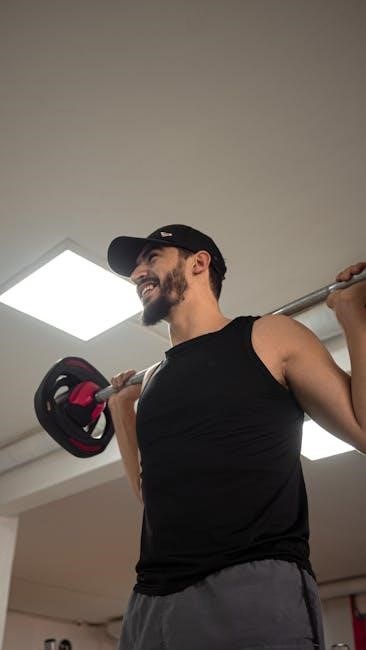
Perform 3-4 sets of 8-12 repetitions for most exercises, increasing weight progressively. Prioritize proper form to prevent injuries and maximize muscle activation.
Leg Exercises
Focus on foundational leg exercises for maximum growth. Begin with Barbell Back Squats (3 sets of 8-12 reps), a cornerstone for overall leg strength and size. Incorporate Front Squats (3 sets of 10-15 reps) to emphasize the quads and improve core stability.
Leg Press (4 sets of 12-15 reps) provides a controlled environment for building strength. Add Romanian Deadlifts (3 sets of 10-12 reps) to target the hamstrings and glutes. Lunges (3 sets of 10-12 reps per leg) enhance balance and unilateral strength.
Prioritize controlled movements and full range of motion for optimal results.
Calf Exercises
Dedicated calf work is crucial for well-rounded leg development. Start with Standing Calf Raises (4 sets of 15-20 reps) to target the gastrocnemius. Utilize a calf raise machine or perform them with dumbbells for added resistance.
Seated Calf Raises (4 sets of 15-20 reps) isolate the soleus muscle, contributing to overall calf size. Focus on a slow, controlled tempo and a full stretch at the bottom of each repetition;
Consider incorporating variations like single-leg calf raises to address any imbalances. Consistent calf training, combined with proper nutrition, will yield noticeable results.
Day 3: Full Body Workout

This session integrates compound and isolation movements for comprehensive muscle activation. Begin with Squats (3 sets of 8-12 reps) and Deadlifts (1 set of 5 reps, 2 sets of 8 reps) to build overall strength and power.
Include Bench Press (3 sets of 8-12 reps) and Overhead Press (3 sets of 8-12 reps) for upper body pushing strength. Supplement with Pull-ups or Lat Pulldowns (3 sets to failure) for pulling movements.
Finish with isolation exercises like Bicep Curls and Triceps Extensions (3 sets of 12-15 reps each) to refine muscle definition. This full-body approach maximizes calorie expenditure and promotes balanced development.
Compound Exercises for Full Body
Compound exercises are foundational for a full-body workout, engaging multiple muscle groups simultaneously. Prioritize Squats – a cornerstone for lower body and core strength – performing 3 sets of 8-12 repetitions.
Deadlifts, crucial for posterior chain development, should be included with 1 set of 5 reps and 2 sets of 8 reps, focusing on proper form. Bench Press (3 sets of 8-12 reps) builds chest, shoulder, and tricep strength.
Overhead Press (3 sets of 8-12 reps) targets shoulders and upper back. These movements maximize efficiency and stimulate significant muscle growth, forming the core of this training day.
Isolation Exercises for Full Body
Complementing compound movements, isolation exercises refine muscle development. Bicep Curls (3 sets of 10-15 reps) target biceps specifically, enhancing arm definition. Triceps Extensions (3 sets of 10-15 reps) isolate triceps for balanced arm growth.
Calf Raises (4 sets of 15-20 reps) focus on calf muscles, improving lower leg strength and aesthetics. Leg Extensions (3 sets of 12-15 reps) isolate quadriceps, while Hamstring Curls (3 sets of 12-15 reps) target hamstrings.
These exercises refine muscle shape and address any imbalances, contributing to a well-rounded physique and optimizing the effectiveness of the full-body workout.
Day 4: Upper Body ⎻ Back & Biceps
Focus on developing a strong and defined back and biceps. Begin with Pull-ups (3 sets to failure) for overall back strength. Follow with Barbell Rows (3 sets of 8-12 reps) to build back thickness. Lat Pulldowns (3 sets of 10-15 reps) further target the lats for width.
Transition to biceps work with Barbell Curls (3 sets of 8-12 reps) for mass. Hammer Curls (3 sets of 10-15 reps) add forearm development. Concentration Curls (3 sets of 12-15 reps) isolate the biceps for peak contraction.
Prioritize proper form to maximize muscle activation and prevent injury during these exercises.
Back Exercises
Strengthen your back with a variety of exercises targeting different muscle groups. Start with Pull-ups (3 sets to failure) – a compound movement for overall back development. Supplement with Barbell Rows (3 sets of 8-12 reps), focusing on controlled movements to build thickness.
Incorporate Lat Pulldowns (3 sets of 10-15 reps) to enhance back width and definition. Seated Cable Rows (3 sets of 12-15 reps) provide a different angle of resistance. Don’t forget Face Pulls (3 sets of 15-20 reps) for rear deltoid and upper back activation.
Maintain proper form throughout each exercise to prevent injury and maximize muscle engagement.
Biceps Exercises
Sculpt well-defined biceps with a focused routine. Begin with Barbell Curls (3 sets of 8-12 reps), a classic exercise for overall biceps mass. Follow with Dumbbell Curls (3 sets of 10-15 reps per arm) for increased range of motion and individual muscle activation.
Hammer Curls (3 sets of 12-15 reps per arm) target the brachialis and brachioradialis, adding thickness to your arms. Concentration Curls (3 sets of 15-20 reps per arm) isolate the biceps for peak contraction. Cable Curls (3 sets of 12-15 reps) provide constant tension.
Prioritize controlled movements and avoid swinging to maximize effectiveness and prevent injury.
Day 5: Shoulders & Abs
Conclude your week with a powerful shoulder and abdominal workout. Begin with Overhead Press (3 sets of 8-12 reps) for overall shoulder development. Incorporate Lateral Raises (3 sets of 12-15 reps) to target the medial deltoids, enhancing shoulder width. Front Raises (3 sets of 12-15 reps) focus on the anterior deltoids.
Rear Delt Flyes (3 sets of 15-20 reps) address the posterior deltoids for balanced shoulder development. For abs, perform Crunches (3 sets of 20-25 reps), Leg Raises (3 sets of 15-20 reps), and Plank (3 sets, holding for 30-60 seconds).
Finish with Russian Twists (3 sets of 15-20 reps per side) for obliques.
Shoulder Exercises
Sculpt well-rounded shoulders with this focused routine. Start with Overhead Press (3 sets of 8-12 reps), a foundational exercise for overall shoulder strength and mass. Follow with Lateral Raises (3 sets of 12-15 reps) to target the medial deltoids, broadening the shoulders.
Next, perform Front Raises (3 sets of 12-15 reps) to emphasize the anterior deltoids. Don’t neglect the rear deltoids; incorporate Rear Delt Flyes (3 sets of 15-20 reps) for balanced development. Consider Arnold Presses (3 sets of 10-12 reps) for a dynamic variation.
Focus on controlled movements and proper form to maximize effectiveness and prevent injury.
Abdominal Exercises
Strengthen your core with a diverse abdominal routine. Begin with classic Crunches (3 sets of 15-20 reps) to target the upper abs. Incorporate Leg Raises (3 sets of 15-20 reps) to engage the lower abdominal muscles effectively. Add Russian Twists (3 sets of 20 reps per side) for obliques.
Planks (3 sets, hold for 30-60 seconds) are crucial for core stability. Bicycle Crunches (3 sets of 20 reps per side) combine cardio and abdominal work. Consider Hanging Leg Raises (3 sets of 10-15 reps) for an advanced challenge.
Focus on controlled movements and maintaining proper form throughout each exercise.

Nutrition for Muscle Growth
Fuel your body for optimal results! Prioritize a balanced diet with sufficient macronutrients, especially protein, alongside adequate hydration to support muscle recovery and growth.
Macronutrient Breakdown
Achieving optimal muscle growth requires a strategic macronutrient approach. Protein is paramount, aiming for approximately 1.6-2.2 grams per kilogram of body weight daily to facilitate muscle repair and synthesis.
Carbohydrates should constitute 40-50% of your total caloric intake, providing the energy needed for intense workouts and replenishing glycogen stores. Opt for complex carbohydrates like whole grains, fruits, and vegetables.
Healthy fats, comprising 20-30% of your diet, are crucial for hormone production and overall health. Include sources like avocados, nuts, seeds, and olive oil.
Carefully adjusting these ratios based on individual needs and activity levels is key to maximizing results while following a 5-day program.
Importance of Protein Intake
Protein is the cornerstone of muscle repair and growth, making adequate intake vital when following a 5-day muscle building program. Muscles are primarily composed of protein, and resistance training causes microscopic damage that requires protein to rebuild stronger.
Aim for 1.6 to 2.2 grams of protein per kilogram of body weight daily, distributed across multiple meals. This ensures a consistent supply of amino acids, the building blocks of protein.
Prioritize complete protein sources like lean meats, poultry, fish, eggs, and dairy. Supplementing with whey or casein protein can be beneficial, especially post-workout.

Insufficient protein intake can hinder recovery, limit muscle growth, and even lead to muscle breakdown, negating the benefits of your training regimen.
Hydration Strategies
Proper hydration is often overlooked, yet it’s crucial for optimal performance and recovery during a 5-day muscle building program. Muscles are approximately 70-80% water, and dehydration can significantly impair strength, endurance, and cognitive function.
Drink water consistently throughout the day, not just during workouts. Aim for at least 3-4 liters daily, adjusting based on activity level and climate.
Electrolytes, lost through sweat, are vital for muscle function. Consider electrolyte-rich beverages or supplements, especially during intense training sessions.
Monitor your urine color – pale yellow indicates adequate hydration, while dark yellow suggests dehydration. Prioritize water intake before, during, and after each workout to maximize results.

Tracking Progress & Adjustments
Consistent tracking using a workout log is essential for monitoring improvements and making necessary adjustments to your 5-day program.
Regularly assess your progress and adapt the program to continually challenge your muscles and achieve optimal results.
Using a Workout Log
Maintaining a detailed workout log is paramount when following a 5-day muscle building program. This isn’t merely about recording weights lifted; it’s about capturing a holistic view of your training journey.
Document each exercise, the sets performed, repetitions completed, and the weight used. Note how you felt during the exercise – was it challenging, easy, or somewhere in between? Include observations about your form and any pain or discomfort experienced.
A well-maintained log allows you to identify patterns, track progressive overload, and pinpoint areas needing improvement. It provides concrete data to inform adjustments to your program, ensuring continued progress and preventing plateaus. Consider using a dedicated notebook, spreadsheet, or fitness app to streamline the logging process.
Progressive Overload Explained
Progressive overload is the cornerstone of any effective muscle building program, including a 5-day split. It’s the principle of continually increasing the demands placed upon your muscles to stimulate adaptation and growth.
This doesn’t always mean lifting heavier weights. You can achieve progressive overload by increasing repetitions, sets, reducing rest times, or improving exercise technique. The key is to consistently challenge your muscles beyond their current capacity.
Your workout log becomes invaluable here, allowing you to track your progress and strategically plan increases. Avoid drastic jumps; small, incremental changes are more sustainable and reduce injury risk. Listen to your body and adjust accordingly.
Adapting the Program to Your Needs
A 5-day muscle building program, even in PDF format, isn’t one-size-fits-all. Adaptation is crucial for long-term success. Consider your current fitness level – beginners may need to start with fewer sets and lighter weights, focusing on form.
If you have limited time, you can modify the schedule, perhaps combining some sessions or shortening workouts. Listen to your body; don’t hesitate to take rest days when needed.
Exercise substitutions are also acceptable, ensuring you target the same muscle groups. Prioritize exercises you enjoy to maintain motivation. Remember, consistency is key, so tailor the program to fit your lifestyle.

Safety Considerations & Warm-up
Prioritize proper form and technique throughout your 5-day program. A thorough warm-up before each session, and cool-down afterward, is essential for injury prevention.

Proper Form & Technique
Maintaining correct form during each exercise is paramount to maximizing results and minimizing the risk of injury within your 5-day muscle building program. Focus on controlled movements, engaging the targeted muscle groups throughout the entire range of motion.
Avoid using momentum or lifting weights that are too heavy, as this can compromise your form and lead to strains or sprains. If you are unsure about the proper technique for a particular exercise, consult with a qualified fitness professional.
Prioritize quality over quantity; it’s better to perform fewer repetitions with perfect form than to rush through a higher number with poor technique. Watch videos, use mirrors, and even record yourself to assess and refine your movements.
Remember, consistency and proper execution are key to achieving your fitness goals safely and effectively.
Warm-up Routine Before Each Session
Before commencing each workout within your 5-day muscle building program, a thorough warm-up is crucial for preparing your muscles and joints for the demands ahead. Begin with 5-10 minutes of light cardio, such as jogging in place, jumping jacks, or cycling, to increase blood flow and raise your core body temperature.
Follow this with dynamic stretching, focusing on movements that mimic the exercises you’ll be performing. Include arm circles, leg swings, torso twists, and hip rotations.
Dynamic stretching improves flexibility and range of motion, reducing the risk of injury. Avoid static stretching before your workout, as it can temporarily decrease muscle power. A proper warm-up enhances performance and ensures a safer, more effective training session.
Cool-down and Stretching
Following each session of your 5-day muscle building program, dedicate 5-10 minutes to a proper cool-down. This involves gradually decreasing your heart rate with light cardio, like walking or slow cycling. This helps prevent dizziness and allows your body to transition back to a resting state.
Crucially, incorporate static stretching, holding each stretch for 20-30 seconds. Focus on the muscle groups worked during that specific workout. Examples include hamstring stretches, quad stretches, chest stretches, and triceps stretches.
Static stretching improves flexibility, reduces muscle soreness, and promotes recovery. Consistent cool-downs and stretching are vital for long-term muscle health and injury prevention.